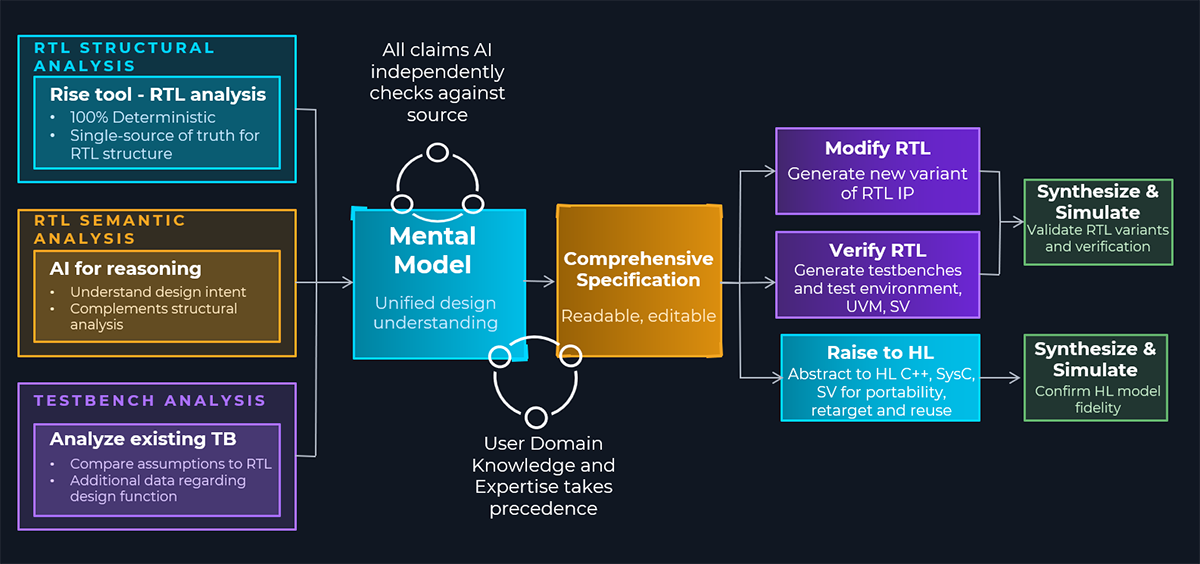
Rise reads your existing Verilog or SystemVerilog designs and testbench data and builds an accurate Mental Model using three independent perspectives. Every claim is independently verified against the source, giving you a comprehensive, readable, and editable record of what your design does.
From that trusted foundation, Rise can generate RTL variants, abstract to high-level models, and create verification environments. This enables teams to quickly make and verify changes to existing designs or raise their abstraction level to unlock full system-level value and make larger architectural changes.
Most AI tools reason about RTL from source code alone. Rise combines three perspectives that no single source can provide on its own.
Structural Analysis — An independent Rise tool deterministically extracts a complete structural understanding of your design: registers, FSMs, memories, pipelines, clock domains, port interfaces, and datapath connectivity.
Semantic Analysis — AI reasoning over your RTL source identifies what your design does: the algorithm, protocol intent, functional decomposition, boundary conditions, and interface contracts. Every inference is cross-checked against the structural analysis.
Your Expertise — Your domain knowledge, IP library patterns, verification methodology, and QoR optimization preferences are first-class inputs. Your guidance overrides both structural and semantic analysis and persists across runs.
The result is a Mental Model that is a unified design understanding where all claims are checked against the source. Structural facts form the backbone that AI inference is validated against, and your guidance is given the highest priority.
Once Rise builds the Mental Model of your design, two powerful flows become available.
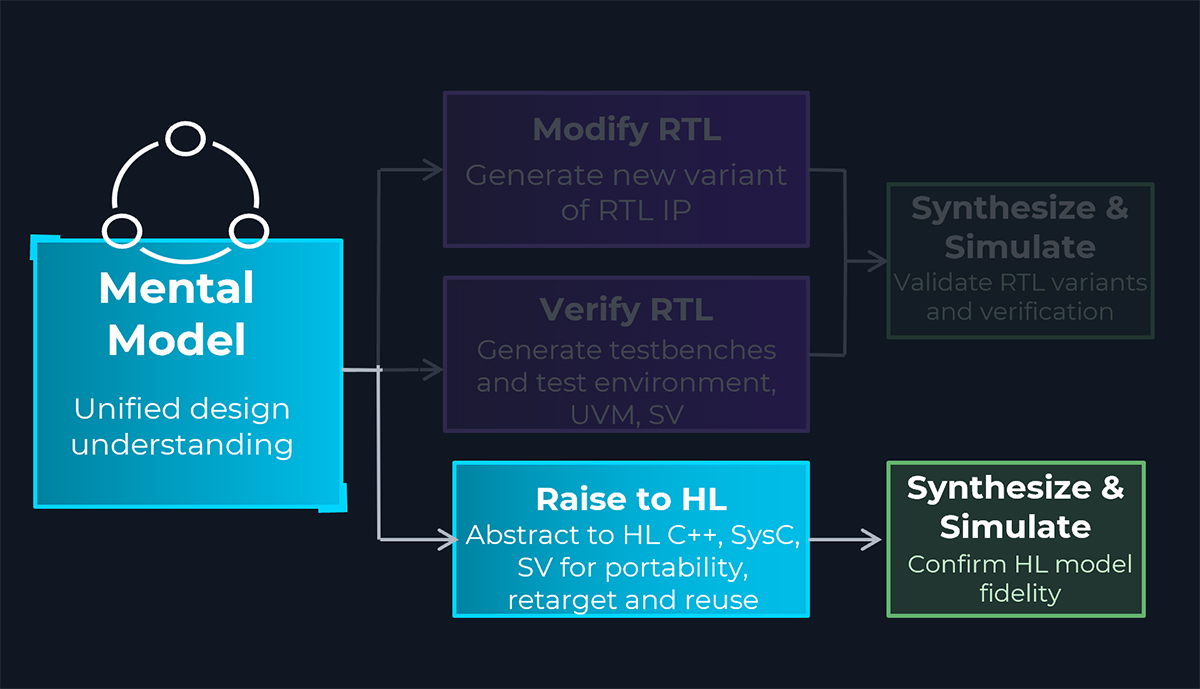
Using the Mental Model created from your existing design, Rise produces a synthesizable HLS implementation in SystemC, C++, or SystemVerilog with streaming interfaces, testbenches, and synthesis results. Because Rise understands the algorithm and not just the structure, it can also enhance the design in ways that would be impractical from RTL alone, adding features, changing interfaces, and retargeting architectures. The output is verified through a closed loop of HLS synthesis and behavioral simulation with structured feedback that enables automatic self-healing on failure
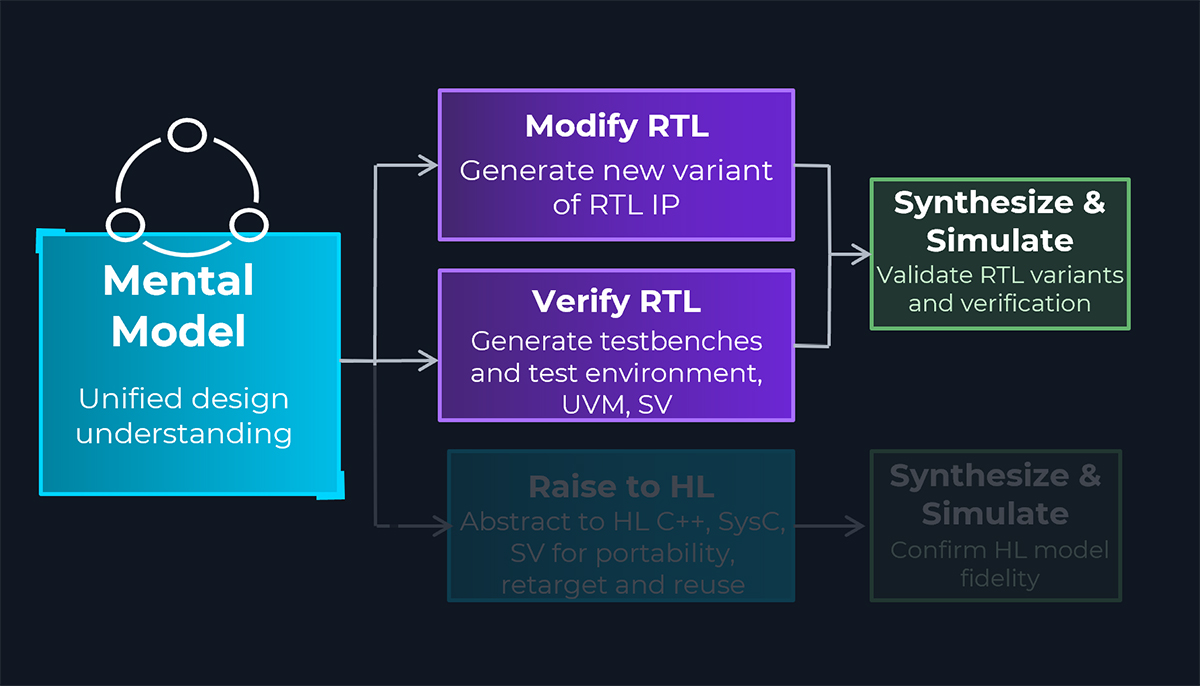
With a deep understanding of your design already established, Rise generates targeted design variants in synthesizable Verilog using natural language instructions, verified by a generated self-checking testbench. The Mental Model identifies precise feature boundaries, including which registers, FSM states, transitions, and datapath expressions belong to a feature, making it possible to strip or add functionality without breaking the rest of the design.
Comprehensive Documentation
Generate readable and editable documentation directly from the Mental Model, capturing design intent, structural facts, and architectural decisions in one place.
Onboard Faster
Give new engineers and AI agents a complete and accurate understanding of undocumented or legacy IP without manual reverse engineering
Modify with Confidence
Generate targeted RTL variants grounded in precise feature boundary analysis, reducing the risk of unintended side effects when changing existing designs.
Raise to High Level and Accelerate System Design
Abstract existing RTL to C++, SystemC, or SystemVerilog behavioral models for portability, retargeting, and reuse. The resulting model is RTL-accurate but 100x faster, enabling early HW/SW co-verification and system-level validation.

Verify from the Model
Generate testbenches and verification environments directly from the Mental Model, covering the original design behavior and any new variants.
Synthesize and Simulate
Validate RTL variants and confirm HL model fidelity through Rise synthesis and simulation, with structured feedback that closes the loop automatically.